
HARD-
MACHINING
INSERT SERIES
NANO-STRUCTURED ALTIN PVD-COATED CARBIDE GRADE
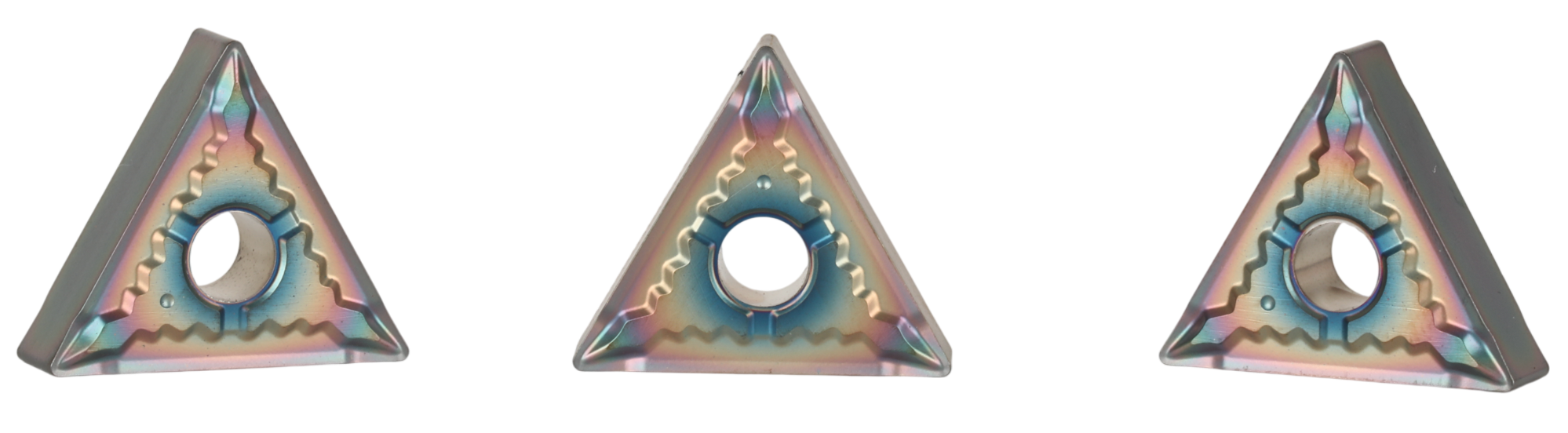
TNMG-EA
CTH410 HARD-MACHINING INSERTS SERIES
INTRODUCING CTH410
NANO-STRUCTURED ALTIN PVD-COATED CARBIDE GRADE
ELEVATING HARDENED-ALLOY MACHINING THROUGH ENGINEERED EDGE CONTROL
CARBIFORCE CTH410 is a nano-structured AlTiN PVD-coated carbide grade developed to improve process control in hardened-alloy machining. Its coating, carbide substrate, and operation-specific geometries work together to maintain cutting-edge definition under elevated temperature, abrasive contact, and concentrated mechanical load.
The 1–4 μm nano-structured AlTiN PVD coating, with a hardness of HV 2,800–4,500, forms a protective interface around the active cutting zone. It supports thermal stability, oxidation resistance, and wear control, while the underlying carbide substrate provides the mechanical strength needed to support the edge during continuous engagement, repeated entry, and application-controlled interrupted cutting.
COATING PROTECTION. SUBSTRATE SUPPORT. CONSISTENT MACHINING.
CORE COATING
TECHNOLOGY
The AlTiN coating chemistry exhibits low chemical affinity with hardened alloys, helping limit material pickup and built-up edge formation. Its low-friction surface supports controlled chip movement, while the hard coating layer resists progressive abrasive wear. Combined with the mechanically supportive carbide substrate, the interface is designed to retain edge definition and consistent machining behaviour.
TNMG–EA
REFINE THE SURFACE. HOLD THE TOLERANCE.
TNMG inserts for hardened steel can be considered where a strong negative-style insert configuration is appropriate for the machine setup and component geometry. The final geometry selection should account for cutting depth, feed, component profile and rigidity.
COATING PROTECTION. SUBSTRATE SUPPORT.
CONSISTENT MACHINING.
This engineered balance allows CTH410 to support predictable wear progression, stable edge engagement, and consistent component accuracy across finishing, semi-finishing, and controlled light-roughing operations. When matched with the correct insert geometry and cutting conditions, the grade helps production teams maintain steady machining performance with fewer unplanned process corrections.
CTH410 is primarily developed for hardened chromium-alloy and chromium-molybdenum steels. Its application range also includes hardened mould steels, die steels, tool steels, quenched-and-tempered alloys and selected heat-treated components up to 60 HRC.
At application-engineered parameters, CTH410 supports controlled chip formation, manageable cutting loads, and consistent edge engagement. This allows cutting speed, feed, and depth of cut to be optimized as one coordinated machining condition supporting higher component output while maintaining process stability.
The published maximum values define the outer working capability of the CTH410 platform under validated conditions. They should not be applied as one universal or simultaneous setting. Final parameters must be selected according to material grade, hardness, insert geometry, component condition, cutting engagement, coolant delivery and machine rigidity.
ONE GRADE PLATFORM FOR MULTIPLE OPERATIONS
Turning
External turning, facing, profiling, boring
Milling
High-feed milling, face machining, pocketing, ramping, pre-finishing
Drilling
U-drilling, blind holes, through holes, production holemaking
Operation-specific geometries allow the CTH410 platform to control chip formation, cutting-force direction and feature generation across hardened shafts, gears, bearing components, forged rings, mould cavities, die blocks and heat-treated machine parts.
The value of CTH410 extends beyond individual insert life. Its purpose is to support consistent component output, stable dimensional control, repeatable surface generation, and predictable edge performance throughout the machining cycle.
ENGINEERED PARAMETERS. REPEATABLE OUTPUT. HIGHER PRODUCTIVITY.
For plant-level evaluation, measure CTH410 by component output per edge, wear progression, dimensional consistency, surface condition, cycle stability, insert-change frequency, and total cutting cost per component.
Share your material grade, hardness, component drawing, machining operation, present insert, and current cutting parameters with Carbiforce Engineering. Our application team will recommend a suitable CTH410 geometry and establish controlled starting parameters for plant validation.
VALIDATE CTH410 ON YOUR COMPONENT.
Share your material grade, hardness, component drawing, machining operation, present insert, and current cutting parameters with Carbiforce Engineering. Our application team will recommend a suitable CTH410 geometry and establish controlled starting parameters for plant validation.
Capability depends on material condition, hardness, insert geometry, cutting operation, engagement, workholding, overhang, coolant delivery, and machine rigidity. Final suitability must be confirmed through application review and controlled plant validation.
Carbiforce CTH410 –Advanced Cutting Solution for High-Hardness Machining
RELIABLE CUTTING PERFORMANCE FOR HARDENED MATERIALS
Machining hardened components requires more than a conventional carbide grade. High workpiece hardness increases cutting forces, accelerates flank and crater wear, generates heat at the cutting edge, and can make dimensional control difficult during finishing operations.
Carbiforce CTH410 is developed as an engineering solution for demanding high-hardness machining applications where tool life, dimensional consistency and predictable cutting performance are critical.
The grade is particularly suited to applications involving hardened steels and difficult-to-machine components, helping manufacturers improve process stability while reducing frequent insert changes and unnecessary production interruptions.
DESIGNED FOR DEMANDING HARD-MACHINING OPERATIONS
Hard machining inserts are selected when conventional cutting tools cannot provide sufficient resistance to wear and thermal stress. In these applications, the cutting edge must remain stable despite high cutting temperatures, interrupted cutting conditions and significant mechanical loads.
CTH410 provides a solution for manufacturers machining hardened components where maintaining edge integrity and repeatable component quality is essential.
The engineering objective is not simply to increase tool life. A suitable cutting solution should also provide:
DEEP DIVE INTO HARD-MACHINING TOPICS
Carbide Technology for Hardened Steel
Selecting the correct substrate and coating combination becomes increasingly important as material hardness increases.
Hardened steel carbide inserts are intended for applications where the cutting edge must withstand elevated mechanical and thermal stresses while maintaining useful edge life.
For production environments, the correct grade should be selected according to workpiece hardness, machining operation, cutting speed, depth of cut, feed rate, rigidity and whether the operation is continuous or interrupted.
Choosing the Right Cutting Solution
Carbide inserts for hardened steel should not be selected solely according to the material name. Two components manufactured from the same steel family can require substantially different tooling depending on hardness, component geometry, and machining conditions.
Carbiforce therefore approaches hard machining as an application-engineering problem rather than a one-grade-fits-all application.
Hard Turning for Hardened Components
Hard turning inserts are used when hardened components need to be machined after heat treatment, reducing or eliminating the requirement for additional grinding operations in suitable applications.
This approach can be particularly valuable for shafts, bearing components, gears, dies, mould components, and other precision parts where post-heat-treatment machining is required.
A stable cutting edge is essential because excessive wear can directly affect component diameter, profile accuracy, and surface finish.
AlTiN PVD Coating for High-Temperature Applications
AlTiN PVD-coated carbide inserts are suited to applications where the cutting zone experiences substantial thermal loading.
The coating technology is intended to provide a protective layer between the cutting tool and workpiece while supporting resistance to wear and elevated cutting temperatures.
For high-hardness machining, coating selection should always be considered together with the carbide substrate, insert geometry, and actual cutting conditions.
Machining High-Hardness Materials
Applications involving inserts for machining 60 HRC steel demand considerably greater control over cutting conditions than conventional machining of annealed material.
At this hardness level, excessive cutting pressure, inadequate machine rigidity or an unsuitable cutting edge can quickly lead to premature tool failure.
For components requiring even more demanding operations, inserts for machining up to 68 HRC offer a tooling option for high-hardness applications where conventional carbide tooling may be less effective.
Actual performance depends on the workpiece material, hardness, operation, machine condition, tool geometry, and cutting parameters. Application trials should therefore establish the optimum operating window.
Hard Milling of Hardened Components
Hard milling inserts are used where hardened components require milling operations after heat treatment.
Hard milling can be particularly useful for tool-and-die components, moulds, hardened cavities and complex profiles where the component geometry makes turning or grinding unsuitable.
The main engineering challenge is controlling heat, cutting forces and edge loading while maintaining the required component geometry.
High-Feed Milling for Hardened Steel
High-feed milling of hardened steel requires careful control of cutter engagement, feed per tooth, radial depth of cut, and machine rigidity.
A high-feed strategy can improve material-removal efficiency when the tooling system and machining conditions are correctly matched to the application.
However, increasing feed without considering cutting engagement and machine capability can increase mechanical loading on the cutting edge. Carbiforce recommends establishing application-specific parameters rather than applying a universal high-feed setting.
U-Drilling in Hardened Applications
U drill inserts for hardened steel require particular attention because drilling generates continuous heat and chip evacuation challenges inside the hole.
Tool selection should consider workpiece hardness, hole diameter, depth-to-diameter ratio, coolant delivery, machine stability, and entry/exit conditions.
For demanding drilling applications, the objective is to maintain predictable hole quality while avoiding excessive edge breakdown and uncontrolled wear.
MATERIAL-SPECIFIC MACHINING SOLUTIONS
Cr-Mo Steel
Cr Mo steel machining inserts are used for components manufactured from chromium-molybdenum steel grades where material strength and heat-treatment conditions can create challenging cutting conditions.
Application requirements vary significantly between annealed, pre-hardened and fully hardened conditions. Tool selection should therefore be based on the actual hardness and machining stage.
Die Steel
Die steel machining inserts are designed for machining applications involving hardened dies and forming components.
These components often combine high hardness with demanding geometric requirements. Stable edge performance is particularly important when machining profiles, pockets and finishing surfaces.
Tool Steel
Tool steel machining inserts are used in applications where high material hardness and wear resistance make conventional machining difficult.
The appropriate solution depends on the steel grade, heat-treatment condition and whether the operation is roughing, semi-finishing, or finishing.
INSERT GEOMETRY SELECTION
Different insert geometries provide different approaches to cutting-edge strength, accessibility and finishing performance.
TNMG
Triangular Negative
TNMG inserts for hardened steel can be considered where a strong negative-style insert configuration is appropriate for the machine setup and component geometry.
The final geometry selection should account for cutting depth, feed, component profile and rigidity.
WHY CARBIFORCE CTH410?
CTH410 is positioned for manufacturers that need a controlled machining solution for high-hardness applications rather than simply a conventional carbide insert.
The grade can be evaluated where manufacturers who are experiencing:
The correct solution depends on the complete machining system. Carbiforce can evaluate the application based on workpiece material, hardness, machine condition, tooling configuration and machining strategy.
FROM TOOL SELECTION TO PROCESS IMPROVEMENT
Tooling performance should be measured at the process level.
A lower-cost insert is not necessarily the lower-cost solution if it produces shorter tool life, more frequent tool changes, or inconsistent component quality. Conversely, extending tool life at the expense of cycle time may not improve total manufacturing economics.
For this reason, Carbiforce focuses on practical engineering parameters such as:
This approach allows manufacturers to evaluate tooling based on production results rather than insert price alone.
RECOMMENDED APPLICATION EVALUATION
Before implementing a new grade across production, Carbiforce recommends evaluating:
These variables determine whether a tooling solution will perform consistently in the actual production environment.
HARD-MACHINING
APPLICATION QUESTIONS
What hardness can CTH410 machine?
CTH410 is intended for demanding high-hardness machining applications, including applications approaching the upper hardness ranges encountered in hardened tool and die components. The practical operating range depends on the material, machining operation and cutting conditions.
CARBIFORCE ENGINEERING SUPPORT
The correct insert is only one part of a successful machining process.
Carbiforce works around the complete application material condition, tooling configuration, machining strategy, and production objective to identify a practical cutting solution.
For demanding hardened-material applications, CTH410 provides a starting point for evaluating tool life, edge stability, surface finish, and overall process economics.
Contact Carbiforce with your machining application and operating conditions to identify the appropriate insert configuration and cutting strategy.
FREQUENTLY ASKED QUESTIONS
Everything you need to know about CTH410
CTH410 is Carbiforce's nano-structured AlTiN PVD-coated carbide grade platform for application-controlled turning, milling and indexable drilling of hardened alloy materials.
REQUEST A CTH410
APPLICATION REVIEW
Share the component drawing, material grade, measured hardness, operation, current insert and holder or cutter, existing cutting parameters, coolant condition, wear photographs, and required production outcome. Carbiforce Engineering will support insert selection, geometry matching, starting parameter definition, and controlled trial planning.